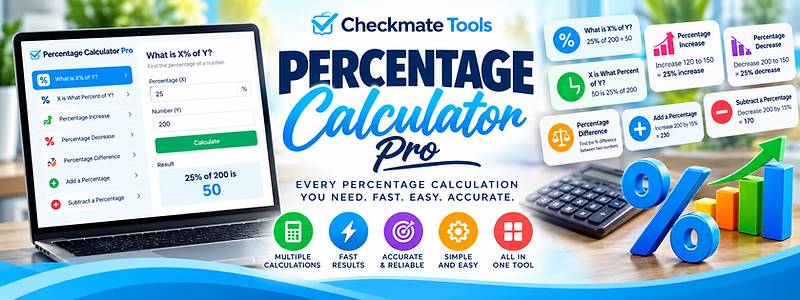
Percentage Calculator Pro
Calculate percentages, percentage changes, increases, decreases, differences, and more with one easy tool.
Calculation type
Selected: What is X% of Y?
Result
—
Choose a calculation type, enter your values, and select Calculate to see the result.
Share result
Copy and share unlock as soon as you have a valid result.
How to Calculate a Percentage
A percentage expresses a part of a whole out of 100. The basic relationship is:
Percentage = (Part ÷ Whole) × 100
Every calculation on this page is a variation of that one relationship. Dividing by 100 turns a percentage into a decimal you can multiply with, and multiplying by 100 turns a decimal back into a percentage.
Common Percentage Calculations
- Percentage of a number
- (Percentage ÷ 100) × Number — for example, 25% of 200 is 50.
- What percent one number is of another
- (Part ÷ Whole) × 100 — for example, 50 is 25% of 200.
- Percentage increase
- ((New − Original) ÷ Original) × 100 — for example, 120 to 150 is a 25% increase.
- Percentage decrease
- ((Original − New) ÷ Original) × 100 — for example, 200 to 150 is a 25% decrease.
- Percentage change
- ((New − Original) ÷ Original) × 100, read in either direction — 100 to 125 is a 25% increase.
- Percentage difference
- |A − B| ÷ ((|A| + |B|) ÷ 2) × 100 — for example, 100 and 120 differ by about 18.18%.
- Adding a percentage
- Number × (1 + Percentage ÷ 100) — 200 increased by 15% is 230.
- Subtracting a percentage
- Number × (1 − Percentage ÷ 100) — 200 decreased by 15% is 170.
Percentage Change vs. Percentage Difference
These two are easy to mix up, and they answer different questions.
Percentage change is used when one value is the original or reference value and another is the new value. Because it divides by the original value, it is not symmetric: going from 100 to 125 is a 25% increase, but going from 125 to 100 is a 20% decrease.
Percentage difference is used when you are comparing two values and neither is necessarily the original or reference value. It divides by the average of the two values, so it is symmetric: the difference between 100 and 120 is the same as the difference between 120 and 100, about 18.18%.
In short: use percentage change when one value came first, and percentage difference when you are simply comparing two measurements.
Frequently asked questions
What is a percentage?
A percentage is a way of writing a number as a fraction of 100. The word means “per hundred”, so 25% is the same as 25 out of 100, or 0.25 as a decimal. Percentages make it easy to compare amounts of different sizes on a single scale.
How do I calculate a percentage of a number?
Convert the percentage to a decimal by dividing it by 100, then multiply by the number. So 25% of 200 is (25 ÷ 100) × 200, which is 0.25 × 200, or 50.
How do I find what percent one number is of another?
Divide the part by the whole and multiply by 100. If 50 is the part and 200 is the whole, then (50 ÷ 200) × 100 = 25, so 50 is 25% of 200. The whole cannot be zero, because the calculation divides by it.
How do I calculate percentage increase?
Subtract the original value from the new value, divide that difference by the original value, then multiply by 100. Going from 120 to 150 gives ((150 − 120) ÷ 120) × 100 = 25, a 25% increase.
How do I calculate percentage decrease?
Subtract the new value from the original value, divide that difference by the original value, then multiply by 100. Going from 200 to 150 gives ((200 − 150) ÷ 200) × 100 = 25, a 25% decrease.
What is percentage change?
Percentage change measures how much a value moved from an original value to a new value, in either direction. The formula is ((New − Original) ÷ Original) × 100. A positive result is an increase, a negative result is a decrease, and a result of zero means the value did not change.
What is percentage difference?
Percentage difference measures how far apart two values are when neither is treated as the original or reference value. The formula is |A − B| ÷ ((|A| + |B|) ÷ 2) × 100. It is symmetric, so the answer is the same whichever value you enter first.
What is the difference between percentage change and percentage difference?
Percentage change uses one value as the original or reference value and compares a second value against it, so swapping the two values changes the answer. Percentage difference treats both values equally and compares them to their average, so swapping the two values does not change the answer. Use change when one value clearly came first, and difference when you are simply comparing two measurements.
Can a percentage be greater than 100%?
Yes. A percentage above 100 simply means more than the whole amount. For example, 150% of 40 is 60, and a value that grows from 100 to 250 has increased by 150%.
Can percentages be negative?
Yes. A negative percentage represents a reduction. Subtracting a percentage larger than the starting amount can also produce a negative result, and this calculator reports it rather than forcing it to zero.
How do I add a percentage to a number?
Multiply the number by (1 + percentage ÷ 100). To add 15% to 200, multiply 200 by 1.15 to get 230. The amount added is 30 and the final value is 230.
How do I subtract a percentage from a number?
Multiply the number by (1 − percentage ÷ 100). To subtract 15% from 200, multiply 200 by 0.85 to get 170. The amount subtracted is 30 and the final value is 170.
Does Checkmate save my calculations?
No. Every calculation runs in your browser. The numbers you enter and the results you get are never sent to a server, never written to a database, and never placed in a URL or in analytics. Press Reset to clear everything at any time.